
PUBLICATIONS & REPORTS
PUBLICATIONS & REPORTS

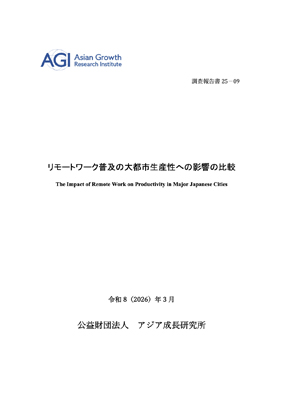
| Author | HATTA Tatsuo, KARATO Koji |
|---|---|
| Affiliation | Asian Growth Research Institute |
| Date of Publication | 2026.3 |
| No. | 2025-09 |
| Download | 926KB |
This paper analyzes how the spread of remote work before and after the COVID-19 pandemic affected agglomeration economies and productivity in Japan’s major cities: Sapporo, Sendai, Tokyo, Nagoya, Osaka, and Fukuoka.
The expansion of remote work reduced the importance of physical proximity, leading to labor shifts from large metropolitan centers to regional cities and from city centers to surrounding areas. Assuming that agglomeration benefits are capitalized into office rents, we employ a hedonic model to examine the relationship between firms’ spatial demand and productivity.
The results show that productivity increased in all cities except Sendai, with particularly notable growth in Sapporo and Fukuoka. Furthermore, in the post-pandemic period, the local effects of agglomeration on productivity became significantly stronger.